Freeze-Dry Design: The Four Phases, the Protectant System and the Protocol Card
Freeze-dried EV powder solves the category's shipping problem: months of shelf life, no cold chain, activated fresh at the point of use. It is also the easiest format to get wrong — cakes that never reconstitute cleanly, payloads that drop 40% through drying, users shaking vials into froth. The difference between the two outcomes is design, and it has four phases.
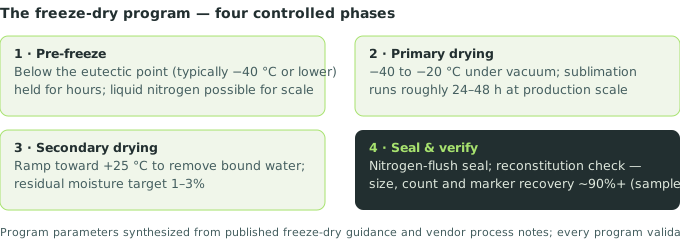
Phase design: what each stage protects
Pre-freeze must take the cake below the eutectic point (typically −40 °C or lower, held for hours) so the matrix freezes as a stable glass rather than collapsing crystal by crystal. Primary drying sublimates bulk ice under vacuum at −40 to −20 °C — the long phase, roughly 24–48 hours at production scale. Secondary drying ramps toward +25 °C to pull out bound water, landing at 1–3% residual moisture: too wet and the cake degrades on the shelf, too dry and membranes stiffen. Seal and verify is the phase a buyer can audit directly: nitrogen-flush seal, then the reconstitution check your customers will judge the powder on — size, count and marker recovery after re-dissolving. Published work and vendor data put recovery at roughly 90% when the protectant system is right.
The cryoprotectant system: trehalose first
The consensus protectant is trehalose — a disaccharide that replaces water molecules in the lipid bilayer as they sublimate, holding the membrane's spacing so vesicles do not fuse or rupture. Working ranges run 1–5% w/v, often paired with mannitol as a bulking agent that gives the cake mechanical structure. Skip the protectant and the literature is unforgiving: vesicles aggregate and leak, with size distribution and payload degrading on the shelf. With it, published reviews report retained particles in the 60–90% range and functional recovery at or above 70% after drying — numbers a program validates on its own retain samples rather than quotes from a brochure.
Tiers and the protocol card
Tier architecture (10 / 50 / 100 mg / 1 g vials) lets one freeze-dry cycle serve many SKUs — dose flexibility without re-validation per format. The last design layer is the one most suppliers skip: the reconstitution protocol card. Activator composition, add order, swirl-don't-shake, use-within-72-hours — printed, brandable, and tested. Reconstitution is where the customer forms their opinion of your powder; leaving it to intuition is how a good cake gets a bad review.
What to ask a supplier
Three questions sort a designed powder from a frozen-then-dried one: What is your cryoprotectant system and loading? What are your residual-moisture and post-reconstitution recovery checks? Does the program card ship with the vials? Our answers live on the RejuvaSILK™ line fact-sheet and in the freeze-dry process playbook — or request a sample and run the reconstitution test yourself.
Get the test panel that matches your batch
Tell us your target category and expected first batch size (a sample run, around 100 units, or 1,000 and up). We will send the matching test panel, characterization references, and a sample COA for your tier.