Open Handling Pays Three Hidden Taxes. A Closed Line Removes All Three.
Ask a contract manufacturer why their exosome batches vary and the honest answer is usually three words: open handling somewhere. Every open step (flask transfer, open centrifugation, manual pooling) adds cost and risk that a fully closed line removes.
Tax one: contamination and yield loss
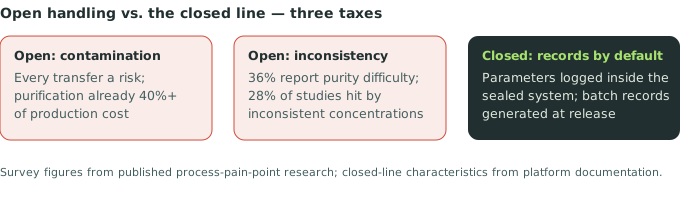
Open workflows lose material at every transfer and risk microbial events that void entire batches. Closed systems fix both: reported protein removal near 99%, purification finished in about 30 minutes on enclosed single-use consumables, and upstream pesticide, heavy-metal and viral exposure eliminated by closed fermentation. In a category where purification alone is estimated at 40%+ of production cost, every recovered percentage point is margin.
Tax two: batch inconsistency
Producers name the failure themselves: 2D flat culture means high labor cost, unstable batch-to-batch uniformity and no realistic path to a closed process. The downstream symptoms are documented in process surveys: 36% of laboratories report difficulty achieving high-purity extraction, 33% report poor reproducibility from ultracentrifugation and precipitation methods, and 28% of clinical studies have been affected by inconsistent vesicle concentrations. Closed lines with logged parameters convert those statistics into batch records.
Tax three: the documentation gap
Open handling leaves record gaps by construction — a transfer done by hand has no sensor log. Closed lines generate records as they run: culture parameters, purification curves and release data attach to the batch automatically. That is why closed manufacturing is the precondition for the scan-to-document traceability professional channels now ask for.
Capital has already picked this architecture: therapeutic-project outsourcing runs near 57%, equipment spend concentrates in single-use bioreactors and TFF, and major CDMOs are acquiring EV platforms.
The buyer's diligence shrinks to one line: show me where the batch is open. If the answer is nowhere — and the records prove it — most of the risk retires with it.
The closed line in detail · What a closed-line COA looks like · Request the records
Get the test panel that matches your batch
Tell us your target category and expected first batch size (a sample run, around 100 units, or 1,000 and up). We will send the matching test panel, characterization references, and a sample COA for your tier.