What a Real EV COA Contains: Seven Items and the Red Flags That End the Call
The COA is the most honest document your supplier will hand you — if you know how to read it. Seven items separate a COA you can build a brand on from a PDF you should walk away from.
1. Batch identification and traceability. Every value on the COA must resolve to one batch — with a code that links to culture records, purification logs and retain samples. A COA without a resolvable batch ID is a flyer.
2. Particle-size distribution, method named.
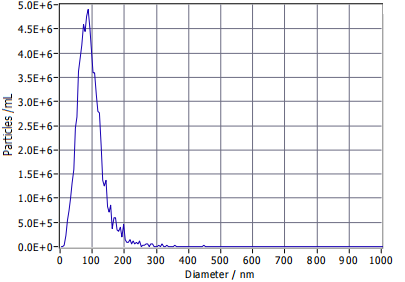
[Figure caption] An actual NTA curve from a TONGNIAN batch — single distribution, method-anchored. Item 2 should look like this. NTA values with the method and instrument class stated, cross-checked by TEM morphology. A size range without a method is a decoration. Best practice anchors to a published measurement guideline — ours follows national guideline 2026 No. 17, which TONGNIAN helped draft.
3. Particle concentration. Stated per mL with the measurement basis, inside configurable tiers (5–100 billion particles/mL on a documented line). "Enriched" is not a number.
4. Endotoxin, with the limit. LAL-based endotoxin values with the release limit printed — "tested" alone proves nothing.
5. Sterility and microbial limits. Membrane-filtration sterility plus microbial limits, negative on release.
6. Payload or purity check. A protein/marker payload or purity figure with the check described — the item most often missing on adjective-only products.
7. Retain-sample statement. The COA should say samples are retained per batch — the difference between a document and an audit trail.
The red flags that end the call: no method names, no release limits, no batch ID, "proprietary blend" in place of payload, and a COA that only arrives after the order — never before you commit.
Every TONGNIAN batch ships with a COA carrying all seven — request a sample COA and read one before you buy.
Get the test panel that matches your batch
Tell us your target category and expected first batch size (a sample run, around 100 units, or 1,000 and up). We will send the matching test panel, characterization references, and a sample COA for your tier.