Exosome Claims: What You Can Say, and What Gets Brands Fined
Exosome claims are where brands die quietly. The record is blunt. China's March 15 consumer-rights broadcast gutted the domestic consumer-exosome market in 2026 over clinical-claim abuse. The FDA has sent warning letters to exosome companies since late 2024. A single FTC action over an 'organic' claim cost $1.76 million. The pattern is constant across markets: the product rarely fails — the copy does.
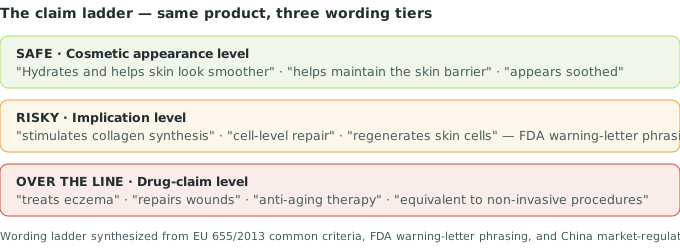
The ladder: same product, three tiers of wording
Regulators in every market read claims on one axis — what does the copy promise?
- Safe (cosmetic, appearance level). "Hydrates and helps skin look smoother." "Helps maintain the skin barrier." "Appears soothed." This is the EU's common-criteria territory (Regulation (EU) No 655/2013: lawful, truthful, supporting evidence, honest, fair, informed decision-making) and the US advertising standard. Our programs ship on-pack copy at exactly this level — appearance claims only.
- Risky (implication level). "Stimulates collagen synthesis." "Regenerates skin cells." "Promotes cellular repair." These phrases appear in FDA warning letters to exosome companies: structure/function implications that turn a cosmetic into an unapproved drug in the reviewer's eyes.
- Over the line (drug-claim level). "Treats eczema." "Repairs wounds." China's market regulators cited their own examples in 2026: "cell-level repair," "a water-gloss injection without breaking skin," "painless thermage" were all cited as medical-effect misrepresentation — alongside notices that human-derived exosome material is not a permitted cosmetic ingredient there at all.
The same vial sits on all three rungs. Nothing about the liquid changes between them — only the sentence around it.
The three habits that keep a brand safe
First: write the claims boundary before the artwork. One product, one sentence of allowed claim space, decided against the destination market's framework (EU CPNP file, US MoCRA listing, China notification) — then copywriters work inside it, not around it. A claim removed at the copy stage is cheap; a claim defended without data is expensive.
Second: keep the documentation chain that backs even the safe claims. "Helps maintain hydration" still needs a file behind it — batch COAs, characterization baselines, the published evidence base (a 2026 systematic review of 19 human studies reports short-term hydration and appearance signals, honestly caveated). When a claim is challenged, the answer is a document, not a defense.
Third: never borrow the incumbent's copy. Half the risky phrases circulating in this category were lifted from another supplier's website — often the very company the regulator cited. Regulators do not accept "the industry says this" as a defense; neither does a clinic's legal review.
The sourcing corollary
If you source exosome products rather than make them, the ladder is your vetting tool: ask a supplier for their on-pack wording and hold it against the middle rung. A supplier whose default copy says "repairs" or "treats" is exporting their claim risk to your shelf.
Our programs are written at the safe rung by default — see the claims discipline section in any playbook, or bring your copy for a route check.
Get the test panel that matches your batch
Tell us your target category and expected first batch size (a sample run, around 100 units, or 1,000 and up). We will send the matching test panel, characterization references, and a sample COA for your tier.