Medspa Post-Procedure Recovery, 0 to 1: The RejuvaSILK™ Build Plan
Playbook scope: a from-0-to-1 delivery plan for a post-procedure recovery line, built for medspas and brand owners. This article publishes methods and measurement definitions only and makes no efficacy claims; all specifications, ratios, MOQs, and lead times herein are indicative placeholders, subject to the mutually confirmed technical documentation and the formal quotation issued via Request a Quote.

RejuvaSILK™ is the skincare track in TONGNIAN's thirteen trademarked lines, covering anti-aging, sensitive skin, and medspa post-procedure recovery. This playbook covers the full 0-to-1 build: positioning, seed and cargo selection, formulation, the 0.5–5 L closed process, the QC panel, EU/US compliance, and MOQ tiers. Methods and specifications only — no performance promises.
01 · Market Positioning: The Medspa Post-Procedure Recovery Segment and Channel Logic
The problem this playbook solves: post-procedure care is the highest-trust moment in aesthetics — and it runs on generic moisturizers, with no documented active and no system a clinic chain can standardize.
Rising penetration of non-invasive aesthetics creates two predictable demand streams: providers need professional-line products to support service protocols and repeat-purchase structures, while brands need differentiated positioning to enter high-ticket scenarios. The playbook answers the channel question first and works backward to product form — SKUs here are designed on a dual track of "professional line for providers + retail line for brands": provider formats (large-volume, reconstitutable, mixed fresh at point of use) and retail formats (sheet masks and small-format lyophilized powder). Both tracks share one EV raw-material platform and one QC baseline, reducing notification and production changeover costs.
Design principles (method level): (1) define dosage forms by use scenario (in-clinic protocols / at-home continuation); (2) define formats and packaging by channel margin structure; (3) define claims boundaries by the notification track. Together, these three determine the seed selection and formulation variables in the next section.
02 · Scientific Rationale: Why Exosomal Material Fits the Post-Procedure Window
Exosomes are nanoscale vesicles (typically 30–150 nm) that cells release to exchange molecular cargo — proteins, lipids, and microRNAs [1]. In dermatology literature, MSC-derived extracellular vesicles are reported to act on several axes relevant to the post-procedure window (reviewed in [1]): epidermal barrier-lipid organization and transepidermal water loss; fibroblast activity and extracellular-matrix remodelling via TGF-β/Smad-type signalling; and visible-calming signals consistent with IL-6/STAT3-type modulation.
The evidence level is stated plainly: a 2026 systematic review of 19 human studies associated topical exosome application with short-term improvements in hydration, elasticity, wrinkle appearance, and overall skin quality — while noting that most included studies were small and not randomized [3]. The line is built to that evidence level: documented material, measured batches, appearance-level claims only. That is exactly the position a clinic can defend to its own clients, and the position the rest of this document is built on.
03 · Internal case experience from network clinics
TONGNIAN's network clinics (Yantai / Dongying) maintain an anonymized case series on exosomal skin and scalp protocols, 2022–2024. The internal case documentation records protocol patterns that directly shaped this line's design — monthly-session facial programs via injection and needle-free infusion routes, with observation points at 30 days, and scalp programs on monthly cadence with 90-day windows. As recorded internally:
- Facial program, single-session trial — client-reported brighter-looking skin tone at the 30-day observation; client continued onto a monthly program.
- Needle-free infusion route, single session — client-reported improved elasticity appearance and a facial-lift impression.
- Scalp program, monthly × 3 — client-reported shedding control and visible thickening at the 90-day window.
We present these entries as internal case documentation — protocol-design references, not clinical trial evidence. The evidence hierarchy stays explicit: published systematic reviews first, internal observational programs second, case documentation third. Formats in this playbook (30-day observation cards, monthly cadence, dual routes) are the design output of that case experience.
The full anonymized series — including the cases behind these protocol patterns — is published in the Case Library.
04 · Seed & Cargo Selection: Candidate Screening Logic
Selection starts from TONGNIAN's cargo knowledge base: 22,554 cargo knowledge base entries (inventory count). AI scoring ranks candidate seeds against category objectives (design targets such as barrier stabilization and matrix environment); roughly 93% of candidate seeds are screened out at the AI triage stage (of candidate seeds screened out by AI scoring), leaving a shortlist that advances to small-sample validation.
Shortlist review criteria: source traceability, consistency across scale-up batches, process compatibility with the target dosage form, and completeness of compliance documentation (INCI / notification basis). Screening-out rates vary with category objectives — this is a statement of method and definitions, not a reference to any specific efficacy outcome.
05 · Formulation Design: The Three-Format Matrix
The playbook specifies three dosage forms sharing one EV raw-material platform: (1) Lyophilized EV powder — the cryoprotectant system and reconstitution protocol are the core design variables, easing shipping and in-clinic fresh mixing; (2) Sheet mask — EVs loaded into a sheet-mask substrate, with the per-mask fill volume as an indicative placeholder, aimed at at-home continuation; (3) Rose-derived plant EVs — a plant-source route managed separately from animal-derived EVs, opening combination-formulation space and supporting brand-side "plant-derived" storytelling.
Each dosage form ships with a specification card: particle-size distribution targets, fill formats, packaging materials, and a stability study plan (all values are indicative and subject to the technical agreement).
06 · Micro-Batch Process: The 0.5–5L Fully Closed Flow (4 Steps)
Production runs inside a 0.5–5L fully closed micro-batch system (fully closed micro-batch scale, per-batch volume), in four steps:
- Seed revival & expansion — inoculation and expansion in closed tubing, with environmental parameters logged throughout;
- Reaction & harvest — harvest points set by each candidate seed's secretion window, with retain samples kept between batches;
- Separation & concentration — the NuoqTFF 1.0 mother unit performs tangential-flow separation and concentration, with transfer in closed tubing;
- Sterile filtration & filling — filled by dosage form (lyophilized powder / sheet-mask filling), with batch records generated. The downstream train layout follows published industrial guidance [5]; a handling rule from published formulation guidance carries through every step — exosomal material does not tolerate high-shear processing, so pump selection, tubing bore and fill rates are qualified at process validation [4].
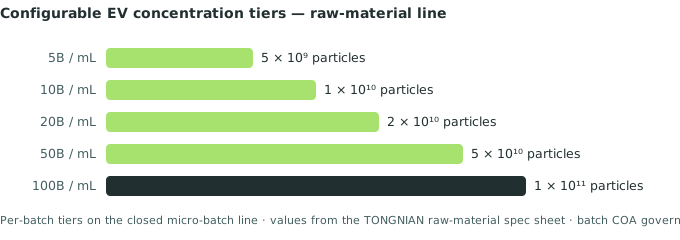
Fig. 1 — Configurable EV concentration tiers on the raw-material line (per the TONGNIAN raw-material spec sheet) — the ceiling a program can spec against.
The micro-batch system matters at the method level: fast changeovers on small volumes, replenishment paced to channel cadence, and full batch traceability — rather than amortizing cost through very large single batches.
07 · QC & Characterization: Batch-Release Test Panel
Every batch ships with batch-release documentation (COA). The panel design follows MISEV2018 [2] and the national measurement guideline [6]. The test panel and method combinations are shown below (all definitions and values in the table are indicative; the batch COA and current standards govern):
| Test item | Method / reference basis | Release criterion (indicative) |
|---|---|---|
| Particle-size distribution | NTA + TEM morphological cross-check | Executed per the national Guideline for Exosome Particle Size and Concentration Measurement (2026 No.17; TONGNIAN is a drafting unit) |
| Particle concentration | NTA | Batch target value (indicative; per batch COA) |
| Purity | Method combination TBD | >99% (indicative, pending QC data) |
| Endotoxin | Gel-clot / kinetic chromogenic method | Limit criterion (indicative; per batch COA) |
| Sterility | Membrane filtration method | Negative (indicative; per batch COA) |
| Batch release | COA + batch records | Delivered with each batch, including a retain-sample plan (indicative) |
08 · Regulatory Pathway: EU & US Cosmetic Frameworks
The line is engineered for EU and US market entry first. In the EU, finished goods follow Regulation (EC) No 1223/2009: CPNP notification before placement, a designated Responsible Person, a Product Information File, and a safety assessment (CPSR). In the US, MoCRA (2022) adds FDA facility registration and product listing; INCI labelling (41316 on the EV ingredient) is the naming standard on both sides of the Atlantic.
The claims discipline is written into the playbook — appearance- and feel-level wording only ("supports hydration," "appears soothed," "helps maintain the skin barrier"), aligned with the EU common criteria for cosmetic claims (Regulation (EU) No 655/2013) and with US advertising standards. No therapeutic claims, efficacy rates, or indications. The strategy is "make no claims — let documents and specifications speak": COAs, notification certificates, and batch records carry channel trust, and the compliance team tracks FDA and EU regulatory movements, sharing updates at playbook review points. For China market entry later, the same material chain maps to the CSAR notification track (INCI 41316 basis) — an additional market, not the primary one.
Documentation comparison (what diligence actually checks)
| Documentation / capability | TONGNIAN baseline | Typical market supplier |
|---|---|---|
| FDA DMF Type II on the material line | On file (044197) | Rare |
| INCI registration | On file (41316) | Occasional |
| National standard drafting seat | Yes (2026 No. 17) | Rare |
| Production environment | Fully enclosed 0.5–5 L micro-batch | Open handling common |
| Batch COA + characterization summary | Every batch | Varies |
| EV concentration options | Configurable tiers to 100B/mL | Often fixed SKUs |
Market-supplier column reflects qualitative channel observation, not a named comparison.
09 · Expected Outcomes: Framing & Evidence Level
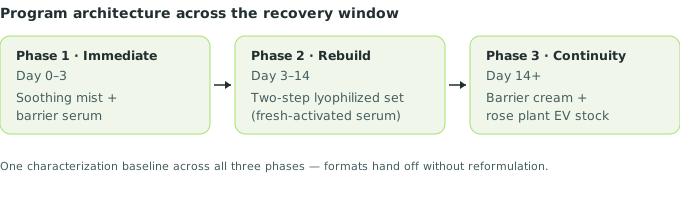
Fig. 2 — The three-phase program architecture the outcomes framing refers to.
What a brand can reasonably state, consistent with published evidence and TONGNIAN's internal observational data:
- Immediate phase (day 0–3): skin feels cooled and comfortable; hydration appearance is supported through the tightness window.
- Rebuild phase (day 3–14): users typically report smoother-feeling texture and a calmer-looking complexion in internal observational programs; published reviews report comparable short-term signals [3].
- Continuity phase (day 14+): the line hands off into the brand's regular products without reformulation — one characterization baseline across every format.
The playbook does not claim accelerated healing, wrinkle removal, or treatment of any condition. The line's authority comes from documentation and measurement, not adjectives — which is why the claims red line in section 08 is written into the program itself. Supporting observational evidence is available to partners: internal medspa aftercare programs, 2024–2026, under NDA [7].
10 · MOQ & Lead-Time Framework (indicative)
The framework below is indicative; official MOQs and lead times are quoted per request — submit a Request a Quote:
| Engagement stage | Volume tier | MOQ / lead-time framework (indicative) |
|---|---|---|
| Sampling & selection | Sample batch | Quoted per request, at sampling scale. |
| Provider professional line | Hundred-unit batch | Quoted per request, at pilot scale. |
| Brand retail line | Thousand-unit+ batch | Quoted per request, at production scale. |
State your stage — sampling, pilot, or production — in the /contact/ form and the quotation follows the same structure, so RFQs map directly to these tiers.
References
- Kalluri R, LeBleu VS. The biology, function, and biomedical applications of exosomes. Science. 2020;367(6478):eaau6977.
- Théry C, Witwer KW, et al. MISEV2018: minimal information for studies of extracellular vesicles — a position paper of the ISEV. J Extracell Vesicles. 2018;7(1):1535750.
- Systematic review of 19 human studies of topical exosome skin applications (hydration, elasticity, wrinkle appearance, overall quality), 2026 — summary via DermatologyNews.net.
- Grand Ingredients. The Technical Reality of Exosomes Beyond Particle Counts; Exosome-Mimetic Systems 2026. Formulation handling and cosmetic-claim phrasing references.
- Cobetter. Exosomes Part I: Applications and Downstream Processing Overview. Technical review, 2025.
- Guideline for Exosome Particle Size and Concentration Measurement (2026 No. 17), national standard — TONGNIAN, drafting organization.
- TONGNIAN. Internal observational data — medspa aftercare programs, 2024–2026 (partner access under NDA).
- TONGNIAN network clinics (Yantai / Dongying). Anonymized internal case documentation — exosomal skin and scalp protocols, 2022–2024.
Apply this playbook to your category
Submit your brand stage, target category, and target volume tier to receive specifications, MOQ, and lead-time quotes for the matching tier (quotation follows the tier structure).