Freeze-Dry Design: Cakes, Cryoprotection, and a Reconstitution Protocol Users Follow
Lyophilized EV powder wins on shipping stability and fails at reconstitution in real hands. This playbook specifies the cryoprotectant system, the tiers, and the reconstitution protocol.
01 · The problem
Lyophilized EV powder is the right format for shipping stability — and the first format to fail in real use: cakes that don't reconstitute cleanly, users shaking instead of swirling, inconsistent doses across reconstitutions. The format isn't the failure — underdesigned cryoprotection and a missing reconstitution protocol are. Both are specified below.
02 · Scientific rationale
Cryoprotection design protects vesicle integrity through freezing and drying: cryoprotectant selection and loading protect membrane structure; controlled freezing rates and drying phases protect cake structure; and the reconstitution protocol (activator composition, add order, swirl-not-shake, use-within window) protects the user experience. Each element is validated on retained samples — payload and post-reconstitution size distribution, batch by batch [4].
03 · Program documentation
Cryoprotection and reconstitution specifications follow TONGNIAN's internal process documentation [6].
Method anchors: [1] EV biology and cargo [2] MISEV2018 characterization [3] category evidence (review or registered study) [4] formulation and handling guidance [5] national measurement guideline (2026 No. 17) [6] internal protocol and case documentation.
04 · Product architecture
| Design element | Specification (indicative — final spec quoted per program) | Role |
|---|---|---|
| Powder tiers | 10 / 50 / 100 mg / 1 g | Dose flexibility by program |
| Cryoprotectant system | Stabilizer loading per cake | Vesicle integrity through drying |
| Activator | Matched serum composition | Fresh activation at use |
| Protocol card | Add order, swirl, 72-h window | Every user reconstitutes the same way |
05 · Process & QC
Lyophilization runs per a controlled freeze-dry program on the closed line; post-dry cakes are checked for structure, and post-reconstitution samples for size distribution and payload. QC per the standard panel [2][5].
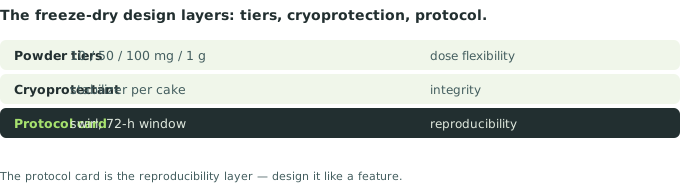
Fig. 1 — The freeze-dry design layers: tiers, cryoprotection, protocol.
06 · Regulatory pathway: EU & US first
Powder formats serve cosmetic and topical programs on the EU/US cosmetic track; the format itself carries no claim burden — the protocol card wording follows the same appearance-level discipline.
07 · Expected outcomes
- Reproducible reconstitution: every kit ships with a protocol card, so each user hits the same dose the batch COA describes.
- Shipping stability: unopened powder tiers travel in insulated lanes and store at 2–8 °C (indicative sample spec).
No claims beyond the destination-market framing — authority comes from documentation and batch measurement.
08 · Commercial framework
Sample kits in 3-5 days; pilot from 500 units; production from 2,000 units; standard lead 15 workdays - all indicative, quoted per request. White-label and program naming run through the OBM program.
Request a quote - Line fact-sheet per program page.
References
- Kalluri R, LeBleu VS. The biology, function, and biomedical applications of exosomes. Science. 2020;367(6478):eaau6977.
- Théry C, et al. MISEV2018. J Extracell Vesicles. 2018;7(1):1535750.
- Cobetter. Exosomes Part I: Applications and Downstream Processing Overview. Technical review, 2025.
- Guideline for Exosome Particle Size and Concentration Measurement (2026 No. 17) — TONGNIAN, drafting organization.
- TONGNIAN internal process documentation — closed-line SOPs, QC panels, batch records (partner access under NDA).
Apply this playbook to your category
Submit your brand stage, target category, and target volume tier to receive specifications, MOQ, and lead-time quotes for the matching tier (quotation follows the tier structure).