What an Exosome Program Really Costs: Five Buckets and the MOQ Ladder
Every brand asks what a program costs. The honest answer is a structure — five buckets and an MOQ ladder — not one figure. This anatomy lays out where the money in an exosome program actually goes, using published industry benchmarks. Benchmarks only. Your real price comes from a quotation — and how a supplier quotes tells you what they are.
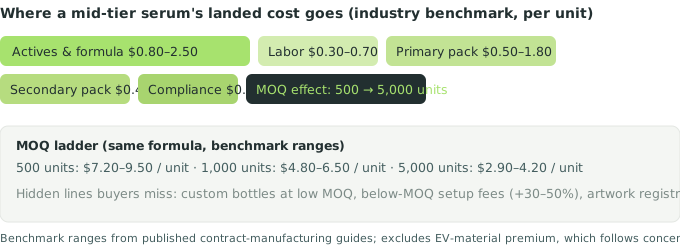
The five buckets
Published contract-manufacturing guides put a mid-tier 30 mL serum's full landed cost in the $2.10–8.00 per unit range before the EV-material premium, and the split is instructive:
- Formula and actives ($0.80–2.50). The widest band, because "actives" is where positioning lives. Simple bases sit near the floor; high-activity formulas run $10–15 per unit at the top end. The exosome material line prices by concentration tier and documentation depth: the premium follows the paper chain.
- Labor ($0.30–0.70). Smaller than buyers expect on automated lines — one of the quiet arguments for closed manufacturing, where changeovers are hours and campaign labor is thin.
- Primary packaging ($0.50–1.80). Industry folklore is true and worth internalizing: the container often costs more than the contents. Glass quality, pump mechanisms and decoration drive this line harder than formula changes do.
- Secondary packaging ($0.40–1.20). Cartons, inserts, program cards — the layer gifting SKUs live and die on.
- Compliance ($0.10–0.30). Notification, listing and documentation per unit at scale. Cheap relative to the risk it removes — and the first line low-cost quotes tend to omit.
The MOQ ladder: the real price lever
The same formula prices wildly differently by batch size: benchmark guides show roughly $7.20–9.50/unit at 500 units, $4.80–6.50 at 1,000, $2.90–4.20 at 5,000. That ladder is why MOQ matters more than unit price. A line that runs 500-unit pilots changes the math for emerging brands: the pilot is not a loss-leader, it is the first row of the ladder.at runs 500-unit pilots on the production line changes the math for emerging brands: the pilot is not a loss-leader, it is the first row of the ladder.
Below-MOQ economics carry their own traps: setup fees of 30–50% for under-MOQ runs, custom bottles priced at 3.00/unit at 10,000 versus 1.80 at 50,000, artwork registration timelines measured in months. These hidden lines — not the formula — are where first-time brands blow their budgets.
The quality correlation
One more benchmark worth pricing in: industry surveys of contract-manufacturing failures attribute the bulk of quality incidents to factory qualification gaps (42%), raw-material control failures (31%), and absent production/QC systems (27%) — while only ~15% of top-tier manufacturers invest more than 5% of revenue in R&D and QC. The cheapest quote on the desk is frequently the expensive one, reordered.
How to use this anatomy
Bring the structure to any negotiation: five buckets, the MOQ ladder, the hidden lines — and ask each supplier to fill it in. A manufacturer answers with a quotation and a documentation chain. A trader answers with a discount.
Request a quote structured exactly this way, or read the COA reading guide for the documentation half of the comparison.
Get the test panel that matches your batch
Tell us your target category and expected first batch size (a sample run, around 100 units, or 1,000 and up). We will send the matching test panel, characterization references, and a sample COA for your tier.