Exosome QC 101: Reading NTA, TEM and Sterility Lines on a COA
A QC characterization primer for brand owners and product teams: what each test item measures and how to read the values. No efficacy claims. All specific limits and example values are mock placeholders; the batch COA and the technical documents confirmed by both parties always prevail.
Most brand owners open an exosome COA and hit the same wall: the numbers are all there — which ones actually matter? This article breaks down the most common test items on a batch release sheet — which method each item uses, which field it maps to in the report, and what to watch for when reading the values. Trust needs a reference point, and that reference point is the method — which is why we call characterization data the industry's currency of trust.
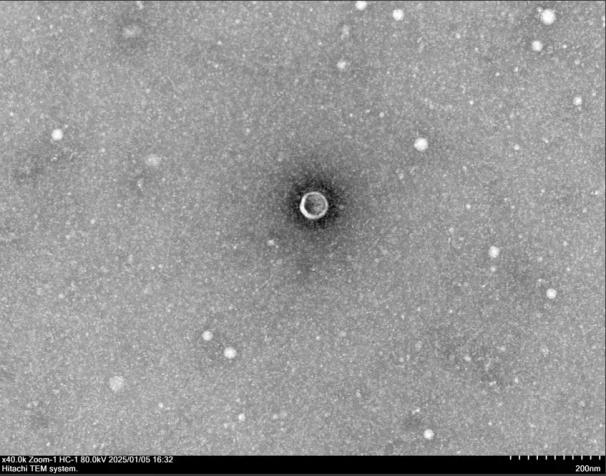
Actual TEM from a TONGNIAN batch release — morphology check, 40,000×, Hitachi TEM system.
01 · Why Characterization Is the Currency of Trust
Most of the early chaos in the exosome industry comes down to one failure: no one could say what was inside, or how much. Without a unified characterization reference, brand owners could only compare prices and stories; with comparable characterization data, the comparison becomes particle size distribution, particle concentration, purity and safety tests — hard references that can be verified line by line. TONGNIAN took part in drafting the national standard Guide for Exosome Particle Size and Concentration Measurement (2026 No.17) as a drafting organization, and runs its test references against group standards including T/CAPS 031–2025, T/CEAC 044–2024, T/CIET 413–2024 and T/CEAC 111–2025. The intent is simple: anchor trust in standards and documents.
The second value of characterization data for brand owners is comparability. How do you compare the same batch across suppliers? Check whether both sides use the same method, the same reference standard and the same way of expressing limits. That is why we advise brand owners to make "test method + reference note" the first question in supplier evaluation: a number without a stated reference cannot be compared.
02 · How to Read the Three Core Test Items
On a batch release sheet, the three core test groups are particle size and concentration (NTA), morphology (TEM) and safety (sterility, endotoxin). The division of labor: NTA provides counts and size distribution, TEM provides morphological confirmation, and sterility and endotoxin define the safety envelope. The table below is a simplified reading guide (indicative references; actual limits are governed by each batch's COA):
| Test item | Method / Reference | Reading notes (indicative, mock) |
|---|---|---|
| Particle size distribution | NTA (nanoparticle tracking analysis), with reference to the national standard Guide for Exosome Particle Size and Concentration Measurement, 2026 No.17 | Check the median size and the shape of the distribution peak; confirm that dilution factor and loading volume are stated alongside the report |
| Particle concentration | NTA | Check particles per mL against the batch target value (mock; the COA governs); repeatability across repeated measurements of the same batch is another point to watch |
| Morphology check | TEM (transmission electron microscopy) | Inspect vesicle morphology and impurities; NTA provides counts and TEM provides morphology — the two corroborate each other rather than substitute for each other |
| Purity — read the number together with its definition and method, stated as a pair on the COA; example values shown, batch COA governs. | ||
| Sterility | Membrane filtration | The result should be negative / not detected (mock indication); note the incubation period and the sampling rules |
| Endotoxin | Gel clot / kinetic chromogenic methods | Limit references are governed by the COA (mock indication); limit requirements may differ across application tracks |
| Batch release | COA + batch records | Verify method, reference, limits and signatures item by item; delivered with the batch together with a retention sample plan |
A common misreading is to benchmark NTA and TEM results directly against each other: NTA statistically tracks the light-scattering signatures of particles in suspension, while TEM images the projected shape of dried, fixed specimens. Different principles never produce identical results — by design, not by error. A proper report names the reference behind each method. The report to distrust gives one number with nothing attached.
03 · What to Look for in a COA
When a COA arrives, read it in four steps. First, sample information: do the batch number, production date, specification and packaging match what you received? Second, the method column: does every test item name its method and reference standard, rather than only reporting a result? Third, results and limits: do the values fall within the stated references, and are the limits supported by a documented basis? Fourth, signatures and traceability: are the issuing party, the reviewer, the batch records and the retention sample plan all in place? Only after these four steps can a COA serve as the basis for supplier evaluation and batch acceptance.
Run this reading process in reverse and you have a brand owner's supplier checklist: ask for the method, the reference standard, the basis for the limits, and batch traceability. For a more complete vetting framework, refer to the TONGNIAN Flexible Biomanufacturing Whitepaper v0.1 and the definition paragraphs for NTA, TEM and endotoxin testing in the Glossary.
Get the test panel that matches your batch
Tell us your target category and expected first batch size (a sample run, around 100 units, or 1,000 and up). We will send the matching test panel, characterization references, and a sample COA for your tier.