Sensitive-Skin Barrier Line: A Documented Calming Active, Not Another Free-From Label
Sensitive-skin marketing has spent a decade competing on subtraction — no fragrance, no alcohol, no preservative — with nothing positive to say. This line adds the missing positive: a documented calming active with batch measurement behind it. documented active — and brands are stuck in a "free-from" arms race with nothing positive to say. Everything below is the complete answer: the barrier science that makes exosomal material credible for sensitive skin, the product architecture, the closed-line process, the EU/US compliance route, and the outcomes frame.
01 · The problem
Sensitive-skin marketing has spent a decade competing on subtraction: no fragrance, no alcohol, no preservative. The category can say what a product doesn't contain — it cannot say what actively helps. Meanwhile the consumer with reactive skin (18–30 core demographic, plus stressed adult skin) sees flare-ups from weather, over-cleansing, and actives overload, and buys calming products on faith.
The missing piece is a documented calming active: an ingredient with traceable manufacturing, batch measurement, and published literature — that still speaks in gentle, cosmetic-track language.
02 · Scientific rationale
Exosomes are nanoscale vesicles (30–150 nm) that cells release to exchange molecular cargo — proteins, lipids, and microRNAs [1]. For sensitive skin, three literature-supported axes matter:
- Barrier lipid organization. Epidermal barrier lipids (ceramides, cholesterol, fatty acids) are the skin's first defense; EV cargo has been associated with barrier-lipid synthesis support in published models.
- Visible-calming signalling. Modulation of IL-6/STAT3-type inflammatory signalling is among the most consistently described MSC-EV actions — the scientific basis for "appears soothed" wording rather than treatment language.
- Formulation survivability. Published formulation guidance is blunt: exosomal material does not tolerate high shear, and cargo stability depends on gentle processing [4] — which is why the line is built on a low-shear closed process rather than blended into conventional high-shear production.
The evidence level: human data for topical exosomes is early — a 2026 systematic review of 19 studies reported short-term improvements in hydration, elasticity and overall appearance, with most studies small and non-randomized. Sensitive-skin positioning therefore stays at "barrier comfort and appearance" level, backed by batch documentation rather than treatment claims.
03 · Internal case experience
TONGNIAN's network clinics maintain an anonymized case series (2022–2024) that includes reactive-skin entries — among them a 27-year-old client with seasonal sensitivity and UV-triggered reactivity, recorded after a single needle-free infusion session with a 30-day observation point; client-reported notes describe reduced visible reactivity and a more even-looking complexion [6]. We present these entries as internal case documentation — protocol-design references that shaped the line's gentle formats — not clinical trial evidence. The evidence hierarchy stays: published reviews first, internal observational programs second, case documentation third.
The full anonymized series — including the cases behind these protocol patterns — is published in the Case Library.
04 · Product architecture
| Layer | Product | Format | Role in the answer |
|---|---|---|---|
| Daily calming | Barrier-companion serum | 30 mL dropper (sample) | Core EV serum, fragrance-minimal base |
| On-the-go calm | Soothing mist | 100 mL spray (sample) | Re-application without touching the skin |
| Weekly support | Calming mask | Sheet mask (sample) | Occasional intensive step |
| Compromised days | Intensive repair gel | 30 g tube (sample) | For visibly stressed periods |
All four share one EV characterization baseline — one specification card covers the line, which makes certification simpler and the story easier to explain to channel.
05 · Process & QC
Production runs on the fully enclosed 0.5–5 L micro-batch line: seed revival in closed tubing, scheduled harvest, tangential-flow separation and concentration, sterile filtration — with low-shear handling qualified at process validation [4]. Characterization follows MISEV2018-aligned panel design [2] and the national measurement guideline (2026 No. 17, TONGNIAN a drafting organization) [5].
| Test item | Method | Release criterion (indicative) |
|---|---|---|
| Particle-size distribution | NTA + TEM cross-check | 80–150 nm (sample) |
| Particle concentration | NTA | Per batch COA |
| Endotoxin | Kinetic chromogenic (LAL) | Per batch COA |
| Microbial limits | Membrane filtration | Negative |
| Batch release | COA + batch records | Every batch |
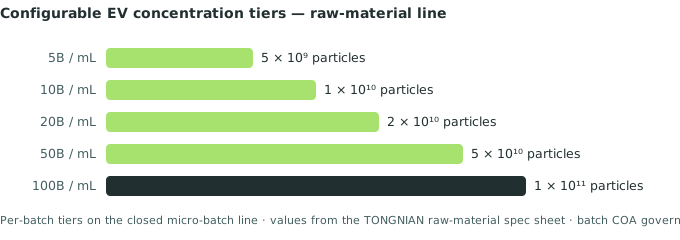
Fig. 1 — Configurable EV concentration tiers on the raw-material line (shared platform).
06 · Regulatory pathway: EU & US cosmetic frameworks
EU: Regulation (EC) No 1223/2009 — CPNP notification, Responsible Person, PIF and safety assessment (CPSR). US: MoCRA (2022) facility registration and product listing. Claims discipline matches the EU common criteria (Regulation (EU) No 655/2013): "supports barrier comfort," "appears soothed," "helps maintain hydration" — never "repairs eczema," never treatment language. The material line's FDA DMF Type II (044197) and INCI 41316 registration sit behind the formula as documentation depth. China market entry later maps to CSAR notification on the same basis — an additional market, not the primary one.
Documentation comparison (what diligence actually checks)
| Documentation / capability | TONGNIAN baseline | Typical market supplier |
|---|---|---|
| FDA DMF Type II on the material line | On file (044197) | Rare |
| INCI registration | On file (41316) | Occasional |
| National standard drafting seat | Yes (2026 No. 17) | Rare |
| Batch COA + characterization baseline | Every batch | Varies |
| Concentration options | Configurable tiers to 100B/mL | Often fixed SKUs |
Market-supplier column reflects qualitative channel observation, not a named comparison.
Fig. 2 — Documentation comparison: the diligence checklist this line passes.
07 · Expected outcomes
Consistent with published evidence [3] and internal observational programs:
- Week 1–2: skin feels less tight after cleansing; hydration appearance supported.
- Week 3–4: visible-redness appearance typically reads calmer in internal observational programs; feel-level comfort is the primary reported change.
- Beyond: the line anchors a "documented calming" shelf story that survives diligence.
No claims are made regarding eczema, rosacea, or any diagnosed condition — reactive-skin positioning stays cosmetic and appearance-level by design.
08 · Commercial framework
Sample kits in 3–5 days; pilot from 500 units; production from 2,000 units; standard lead 15 workdays — all indicative, quoted per request. White-label packaging and program naming run through the OBM program. Reference program: Barrier-companion gel.
Request a quote · Explore RejuvaSILK™ line
References
- Kalluri R, LeBleu VS. The biology, function, and biomedical applications of exosomes. Science. 2020;367(6478):eaau6977.
- Théry C, Witwer KW, et al. MISEV2018: minimal information for studies of extracellular vesicles. J Extracell Vesicles. 2018;7(1):1535750.
- Systematic review of 19 human studies of topical exosome skin applications, 2026 — summary via DermatologyNews.net.
- Grand Ingredients. The Technical Reality of Exosomes Beyond Particle Counts; Exosome-Mimetic Systems 2026.
- Guideline for Exosome Particle Size and Concentration Measurement (2026 No. 17), national standard — TONGNIAN, drafting organization.
- TONGNIAN network clinics. Anonymized internal case documentation — skin protocols, 2022–2024.
Apply this playbook to your category
Submit your brand stage, target category, and target volume tier to receive specifications, MOQ, and lead-time quotes for the matching tier (quotation follows the tier structure).