Seed Sourcing & AI Scoring: Fix Batch Variability Upstream, Not Downstream
EV quality is decided upstream at seed selection, where sourcing is opaque and seed differences go unmeasured. This playbook shows the scored, documented seed library that fixes batch variability where it starts. is the industry's weakness; a scored, documented seed library is the moat.
01 · The problem
Every downstream claim about an exosome program — consistency, characterization, batch comparability — is decided upstream at seed selection. The industry's weakness is exactly there: sourcing is opaque, seed differences go unmeasured, and batch variability gets discovered downstream where it is expensive. A scored, documented seed library turns upstream into the moat.
02 · Scientific rationale
The method: the seed library is screened by AI scoring against category objectives — each candidate scored 0–100; only the top tier advances to small-sample validation. (Exact library count and admission rate per platform page.) Shortlist review covers source traceability, scale-up consistency, process compatibility, and documentation completeness. Selection rates vary by category objective — the scoring is a method statement, not an efficacy claim.
03 · Program documentation
Scoring methodology, tier definitions, and admission rates follow TONGNIAN's internal seed-platform documentation [6]; the tier architecture is summarized on the platform page (sample figures marked).
Method anchors: [1] EV biology and cargo [2] MISEV2018 characterization [3] category evidence (review or registered study) [4] formulation and handling guidance [5] national measurement guideline (2026 No. 17) [6] internal protocol and case documentation.
04 · Product architecture
| Stage | Output | Gate |
|---|---|---|
| Library screening | AI potential scores (0–100) | Elite-tier admission |
| Shortlist review | Traceability + consistency file | Documentation completeness |
| Small-sample validation | Program-fit confirmation | Production admission |
05 · Process & QC
Admitted seeds run small-sample validation on the closed line before program admission; scoring and validation records are retained per seed. QC per the standard panel [2][5].
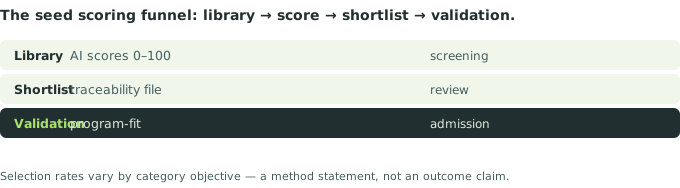
Fig. 1 — The seed scoring funnel: library → score → shortlist → validation.
06 · Regulatory pathway: EU & US first
The seed file is the origin of the documentation chain: it feeds every downstream route — cosmetic, supplement, professional.
07 · Expected outcomes
- Comparable batches by design: comparability starts at scored seeds, not at the finished vial.
- Selection transparency: method published, admission gated.
- The moat: a scored library cannot be copied by a label brand.
No claims beyond the destination-market framing — authority comes from documentation and batch measurement.
08 · Commercial framework
Sample kits in 3-5 days; pilot from 500 units; production from 2,000 units; standard lead 15 workdays - all indicative, quoted per request. White-label and program naming run through the OBM program.
Request a quote - Line fact-sheet per program page.
References
- Kalluri R, LeBleu VS. The biology, function, and biomedical applications of exosomes. Science. 2020;367(6478):eaau6977.
- Théry C, et al. MISEV2018. J Extracell Vesicles. 2018;7(1):1535750.
- Cobetter. Exosomes Part I: Applications and Downstream Processing Overview. Technical review, 2025.
- Guideline for Exosome Particle Size and Concentration Measurement (2026 No. 17) — TONGNIAN, drafting organization.
- TONGNIAN internal process documentation — closed-line SOPs, QC panels, batch records (partner access under NDA).
Apply this playbook to your category
Submit your brand stage, target category, and target volume tier to receive specifications, MOQ, and lead-time quotes for the matching tier (quotation follows the tier structure).