The Missing Premium Scalp Ritual: A Documented 90-Day Home Line
The problem this playbook solves: scalp care stops at anti-shedding shampoos — the premium, documented ritual layer above them is empty, and consumers with scalp stress have no product they can trust on diligence.
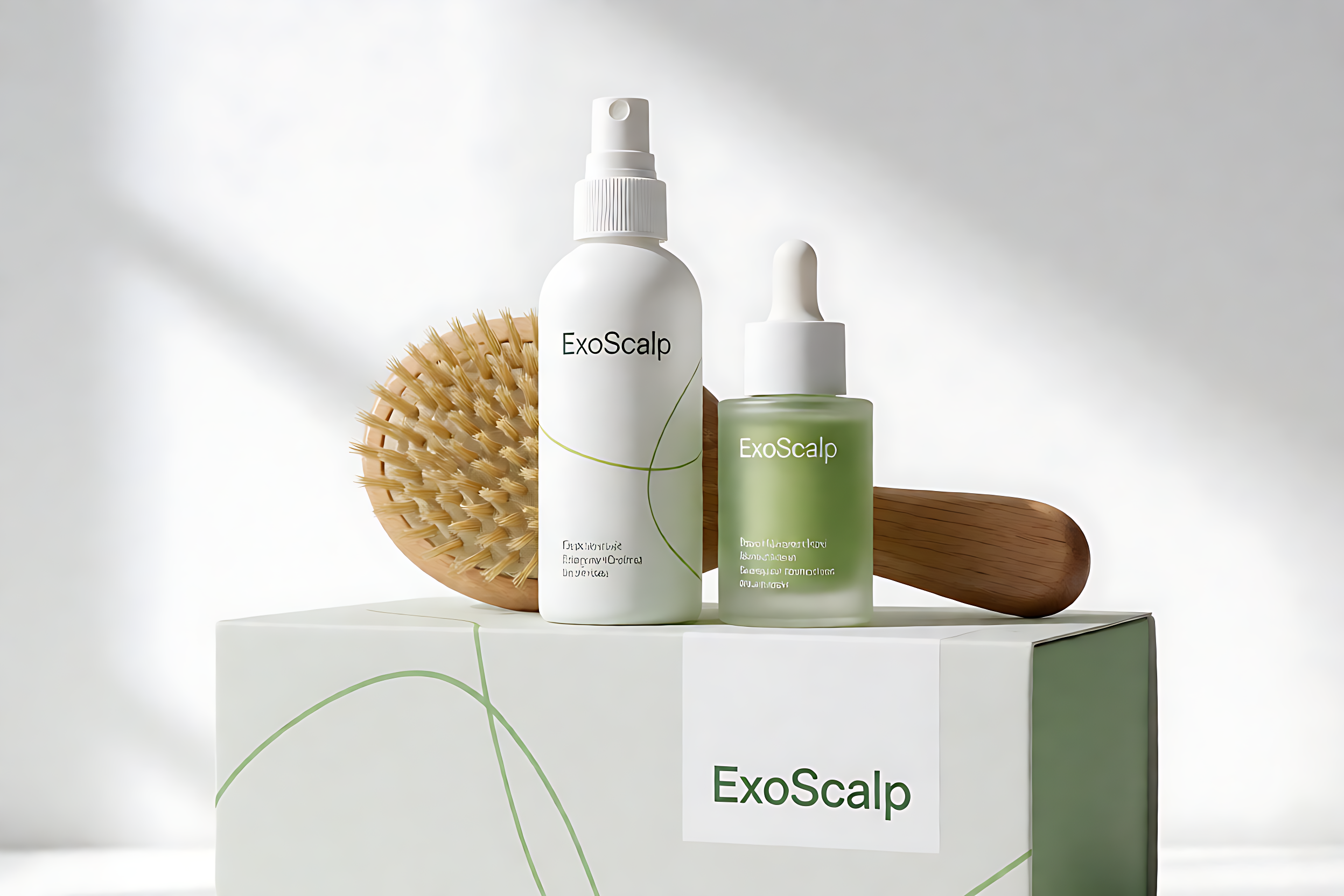
01 · The problem
Scalp shelves are two-tiered and both tiers are thin: drugstore anti-shedding shampoos at the bottom, clinic procedures at the top. Between them — where consumers with work-stressed scalps, styling damage, and visible thinning actually live — there is no premium ritual product with a documented material story. Published protocol literature treats exosome-based scalp programs as an emerging class [1]; no brand has systematized it as a home-ritual line with batch documentation.
The gap is threefold: no documented active (anti-shedding claims ride on actives with thin files), no ritual structure (shampoos wash out; serums read clinical and put daily users off), no clinic bridge (scalp services exist but don't continue at home).
02 · Scientific rationale
Exosomes are nanoscale vesicles carrying proteins, lipids, and microRNAs between cells [2]. For the scalp, the literature focus is the dermal papilla: published protocol work on exosome-based scalp therapies describes MSC-EV paracrine cargo modulating dermal-papilla biology and the perifollicular environment [1]. Reported programme structures in that literature — session-based application, monthly cadence, multi-month observation — align with what internal case documentation shows in TONGNIAN's network clinics (section 03).
Rose-derived plant EV fractions extend the story topically: plant EV carriers with a cosmetics-friendly origin narrative, on the same characterization baseline as the animal-source material. The evidence level: an emerging protocol class with early human signal. The line therefore sells ritual, documentation, and feel — appearance-level wording only.
03 · Internal case experience
TONGNIAN's network clinic documentation includes a representative scalp entry (2023, anonymized): a 47-year-old client with progressive shedding under work stress, recorded onto a monthly exosomal scalp program with a 90-day observation window; client-reported notes describe shedding control and visible thickening at the window [5]. Three entries of this pattern shaped the line's design decisions: monthly cadence (not daily), 90-day program length (not 30), and a dual route (home mist + clinic program). These are case-documentation references, not trial evidence — the evidence hierarchy stays: published reviews first, internal observational programs second, case documentation third.
Method anchors: [1] EV biology and cargo [2] MISEV2018 characterization [3] category evidence (review or registered study) [4] formulation and handling guidance [5] national measurement guideline (2026 No. 17) [6] internal protocol and case documentation.
The full anonymized series — including the cases behind these protocol patterns — is published in the Case Library.
04 · Product architecture
| Layer | Product | Format | Role in the answer |
|---|---|---|---|
| Daily ritual | Scalp soothing mist | 100 mL leave-on (sample) | Between-wash cooling application, no rinse |
| Concentrate | Scalp essence | 50 mL dropper (sample) | Nightly massage into target areas |
| Clinic bridge | Scalp program kit | Backbar + aftercare minis (sample) | The clinic version of the same baseline |
| Inside-out pairing | Oral softgel | Via OralBio™ line | Cross-line extension, same documentation chain |
One characterization baseline across all four — the mist, the essence, the clinic kit, and the oral pairing are siblings, so a brand can build a complete ritual without re-opening development.
05 · Process & QC
EV material is produced on the fully enclosed 0.5–5 L micro-batch line (closed-tubing culture, scheduled harvest, TFF separation and concentration, sterile filtration), with rose-derived plant EV fractions processed on the same characterization baseline. QC follows MISEV2018-aligned panel design [3] and the national measurement guideline (2026 No. 17, TONGNIAN a drafting organization) [6].
| Test item | Method | Release criterion (indicative) |
|---|---|---|
| Particle-size distribution | NTA + TEM cross-check | 80–200 nm, band set per format (sample) |
| Particle concentration | NTA | Per batch COA |
| Endotoxin | Kinetic chromogenic (LAL) | Per batch COA |
| Microbial limits | Membrane filtration | Negative |
| Batch release | COA + batch records | Every batch |
06 · Regulatory pathway: EU & US cosmetic frameworks
The home line is cosmetic-track on both sides of the Atlantic: EU — Regulation (EC) No 1223/2009, CPNP notification, Responsible Person, PIF/CPSR; US — MoCRA (2022) registration and listing. Claims stay at scalp-balance and feel level ("cooling comfort," "balances the scalp environment") — no hair-growth therapeutic claims, which is the category's most common compliance failure. The clinic program is professional-use labelled. For China market entry later, the material chain maps to the CSAR track — an additional market, not the primary one.
Documentation comparison (what diligence actually checks)
| Documentation / capability | TONGNIAN baseline | Typical market supplier |
|---|---|---|
| FDA DMF Type II on the material line | On file (044197) | Rare |
| INCI registration | On file (41316) | Occasional |
| National standard drafting seat | Yes (2026 No. 17) | Rare |
| Batch COA + characterization baseline | Every batch | Varies |
| Concentration options | Configurable tiers to 100B/mL | Often fixed SKUs |
Market-supplier column reflects qualitative channel observation, not a named comparison.
Fig. 1 — Documentation comparison: what a diligence reviewer checks against the line.
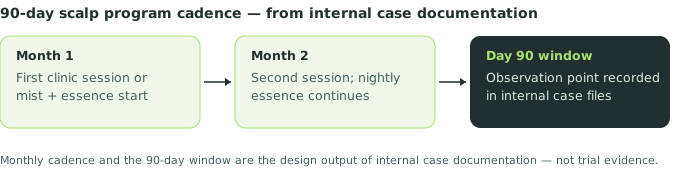
Fig. 2 — The 90-day cadence shaped by internal case documentation.
07 · Expected outcomes
Consistent with the emerging protocol literature [1] and internal case documentation [5]:
- Week 1–4: scalp feels cooler and less reactive between washes; the mist's comfort is the reported change.
- Day 90: the program window used in internal case documentation — clients recorded shedding-pattern notes and visible thickening impressions at this window; programs are designed around it.
- Beyond: ritual adherence is the metric — monthly cadence and a 90-day arc give the brand a subscription-shaped product with a documented story.
No claims are made regarding hair regrowth treatment or any diagnosed condition — positioning stays at scalp-environment and ritual level.
08 · Commercial framework
Sample kits in 3–5 days; pilot from 500 units; production from 2,000 units; standard lead 15 workdays — all indicative, quoted per request. The clinic kit runs professional-use labelling through the same baseline. Reference program: Scalp soothing mist.
Request a quote · Explore ExoScalp™ line
References
- Exosome-based therapies: protocol development for androgenetic alopecia. J Cosmet Dermatol. doi:10.1097/sc9.0000000000000048.
- Kalluri R, LeBleu VS. The biology, function, and biomedical applications of exosomes. Science. 2020;367(6478):eaau6977.
- Théry C, Witwer KW, et al. MISEV2018. J Extracell Vesicles. 2018;7(1):1535750.
- Grand Ingredients. The Technical Reality of Exosomes Beyond Particle Counts. Formulation handling reference.
- TONGNIAN network clinics. Anonymized internal case documentation — scalp protocols, 2023.
- Guideline for Exosome Particle Size and Concentration Measurement (2026 No. 17), national standard — TONGNIAN, drafting organization.
- Alopecia treatment using minimally manipulated human umbilical cord-derived mesenchymal stem cells: three case reports and review of literature. World J Clin Cases. 2021;9(15):3741-3751. doi:10.12998/wjcc.v9.i15.3741.
- The effect of conditioned media from human adipocyte-derived mesenchymal stem cells on androgenetic alopecia after non-ablative fractional laser treatment. Dermatol Surg. 2020;46(12):1698-1704. doi:10.1097/DSS.0000000000002518.
- Clinical use of conditioned media of adipose tissue-derived stem cells in female pattern hair loss: a retrospective case series study. Int J Dermatol. 2015;54(6):730-735. doi:10.1111/ijd.12650.
Apply this playbook to your category
Submit your brand stage, target category, and target volume tier to receive specifications, MOQ, and lead-time quotes for the matching tier (quotation follows the tier structure).