Scalp Clinic Program: Turn Chair Time Into Backbar, Aftercare, and Home Sales
Scalp menus are growing and converting no product revenue: backbar is generic, aftercare is a shampoo tip, home continuity is unserved. This playbook productizes all three on one documented EV baseline. aftercare, and home continuity are three unsold opportunities in one chair.
01 · The problem
Scalp services (detox, massage, care programs) are among the fastest-growing clinic menus — and the least productized: services run on generic backbar, aftercare is a shampoo recommendation, and the home ritual is unserved. A protocolized program — backbar formats, aftercare minis, home bridge — turns chair time into documented, repeatable revenue with retail margin attached.
02 · Scientific rationale
The program uses the same characterized EV baseline as the home line (mist, essence) in professional formats, following the session-and-window structure recorded in TONGNIAN's scalp case documentation — monthly sessions with a 90-day observation arc [5]. Published scalp-EV protocol work follows the same session logic, which keeps the clinic protocol inside cosmetic-service boundaries.
03 · Program documentation
Scalp protocol patterns follow TONGNIAN's internal scalp case documentation (monthly sessions, 90-day windows) [6].
Method anchors: [1] EV biology and cargo [2] MISEV2018 characterization [3] category evidence (review or registered study) [4] formulation and handling guidance [5] national measurement guideline (2026 No. 17) [6] internal protocol and case documentation.
04 · Product architecture
| Component | Format (sample) | Role |
|---|---|---|
| Backbar concentrates | Multi-use bulk sizes | Applied by the therapist during each session |
| Aftercare minis | Take-home set | Continuity between visits |
| Home bridge | Mist + essence (retail) | The 90-day ritual at home |
05 · Process & QC
EV material runs on the fully enclosed 0.5–5 L micro-batch line with low-shear handling qualified at process validation [4]. QC panel design follows MISEV2018 [2] and the national measurement guideline (2026 No. 17, TONGNIAN a drafting organization) [5].
| Test item | Method | Release criterion (indicative) |
|---|---|---|
| Particle-size distribution | NTA + TEM cross-check | 80–150 nm (sample) |
| Particle concentration | NTA | Per batch COA |
| Endotoxin | Kinetic chromogenic (LAL) | Per batch COA |
| Microbial limits | Membrane filtration | Negative |
| Batch release | COA + batch records | Every batch |
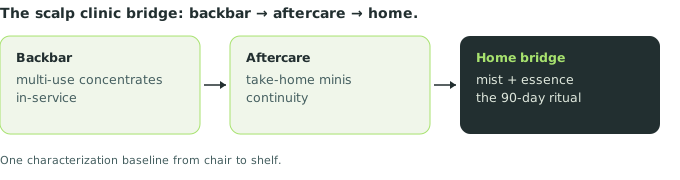
Fig. 1 — The scalp clinic bridge: backbar → aftercare → home.
06 · Regulatory pathway: EU & US first
EU: Regulation (EC) No 1223/2009 — CPNP notification, Responsible Person, PIF/CPSR. US: MoCRA (2022) registration and listing; INCI labelling (41316). Appearance-level claims only per EU Reg. 655/2013 and US advertising standards. China market entry later maps to the CSAR track — additional market. Clinic backbar runs professional-use labelling; scalp-balance wording only — no hair-growth therapeutic claims.
07 · Expected outcomes
- Menu economics: a protocolized scalp tier carries service margin plus aftercare retail.
- Continuity by design: the home bridge keeps clients on the baseline between visits.
- Documented material on a shelf where scalp claims are usually the thinnest.
No claims are made beyond the destination-market framing — authority comes from documentation and batch measurement.
08 · Commercial framework
Sample kits in 3–5 days; pilot from 500 units; production from 2,000 units; standard lead 15 workdays — all indicative, quoted per request. White-label runs through the OBM program.
Request a quote · Line fact-sheet
References
- Kalluri R, LeBleu VS. The biology, function, and biomedical applications of exosomes. Science. 2020;367(6478):eaau6977.
- Exosome-based therapies: protocol development for androgenetic alopecia. J Cosmet Dermatol. doi:10.1097/sc9.0000000000000048.
- Théry C, et al. MISEV2018. J Extracell Vesicles. 2018;7(1):1535750.
- Guideline for Exosome Particle Size and Concentration Measurement (2026 No. 17) — TONGNIAN, drafting organization.
- TONGNIAN network clinics. Anonymized internal protocol and case documentation (partner access under NDA).
- Alopecia treatment using minimally manipulated human umbilical cord-derived mesenchymal stem cells: three case reports and review of literature. World J Clin Cases. 2021;9(15):3741-3751. doi:10.12998/wjcc.v9.i15.3741.
- The effect of conditioned media from human adipocyte-derived mesenchymal stem cells on androgenetic alopecia after non-ablative fractional laser treatment. Dermatol Surg. 2020;46(12):1698-1704. doi:10.1097/DSS.0000000000002518.
- Clinical use of conditioned media of adipose tissue-derived stem cells in female pattern hair loss: a retrospective case series study. Int J Dermatol. 2015;54(6):730-735. doi:10.1111/ijd.12650.
Apply this playbook to your category
Submit your brand stage, target category, and target volume tier to receive specifications, MOQ, and lead-time quotes for the matching tier (quotation follows the tier structure).