OBM Onboarding — Brief, Sample, Pilot, Production: Four Steps with Defined Returns
The problem this playbook solves: brands do not know how to start with an exosome manufacturer — the four-step onboarding path (brief, sample, pilot, production) makes the first move obvious.
01 · The problem
Brands arrive with a category idea and leave without a path: exosome manufacturing is opaque, MOQs look like walls, and nobody explains what step one is. The onboarding answer is a written four-step path — brief, sample, pilot, production — where each step has defined returns and a clear exit into the next.
02 · Scientific rationale
The path is designed around proof accumulation: the brief returns a program recommendation; the sample (3–5 days) returns a characterization baseline the brand can test; the pilot (500 units) returns a sellable batch with full COA chain; production scales the same line without re-validation.White-label scope follows the same gates: naming and card at pilot, full packaging at production.
03 · Program documentation
Onboarding steps run on TONGNIAN's internal program-management documentation; every stage output lands in the brand's documentation pack [6].
Method anchors: [1] EV biology and cargo [2] MISEV2018 characterization [3] category evidence (review or registered study) [4] formulation and handling guidance [5] national measurement guideline (2026 No. 17) [6] internal protocol and case documentation.
04 · Product architecture
| Step | Returns | Timing (indicative) |
|---|---|---|
| 1 · Brief | Program recommendation | 1 session |
| 2 · Sample | Characterization baseline + kits | 3–5 days |
| 3 · Pilot | A sellable 500-unit batch with the full COA chain | Scheduled per program |
| 4 · Production | 2,000+ units | Standard 15 workdays |
05 · Process & QC
Each step is a gate: no pilot before the brief's program fit, no production before pilot sell-through review. QC runs the standard panel: MISEV2018 characterization plus the 2026 No. 17 measurement guideline.
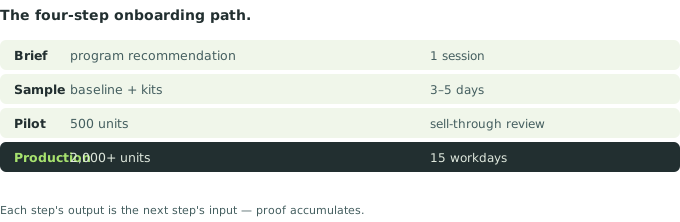
Fig. 1 — The four-step onboarding path.
06 · Regulatory pathway: EU & US first
The route (cosmetic, supplement, professional) is confirmed at the brief — the matrix from the compliance playbook is filled in at step one.
07 · Expected outcomes
- A concrete first step: one brief session returns a written program recommendation.
- Proof accumulates: each step's output is the next step's input.
- White-label depth scales with brand stage, not all upfront.
Wording stays inside each destination market's rules; batch measurement does the persuading.
08 · Commercial framework
Sample kits in 3-5 days; pilot from 500 units; production from 2,000 units; standard lead 15 workdays - all indicative, quoted per request. White-label and program naming run through the OBM program.
Request a quote - Line fact-sheet per program page.
References
- Kalluri R, LeBleu VS. The biology, function, and biomedical applications of exosomes. Science. 2020;367(6478):eaau6977.
- Théry C, et al. MISEV2018. J Extracell Vesicles. 2018;7(1):1535750.
- Guideline for Exosome Particle Size and Concentration Measurement (2026 No. 17) — TONGNIAN, drafting organization.
- TONGNIAN internal process documentation — closed-line SOPs, QC panels, batch records (partner access under NDA).
Apply this playbook to your category
Submit your brand stage, target category, and target volume tier to receive specifications, MOQ, and lead-time quotes for the matching tier (quotation follows the tier structure).