Needle-Free Microcrystal Delivery — Precision Placement on One Characterized EV Base
The problem this playbook solves: needle-averse consumers and device partners have no matched consumable system — placement-precise delivery without needles is an unopened pairing market.
01 · The problem
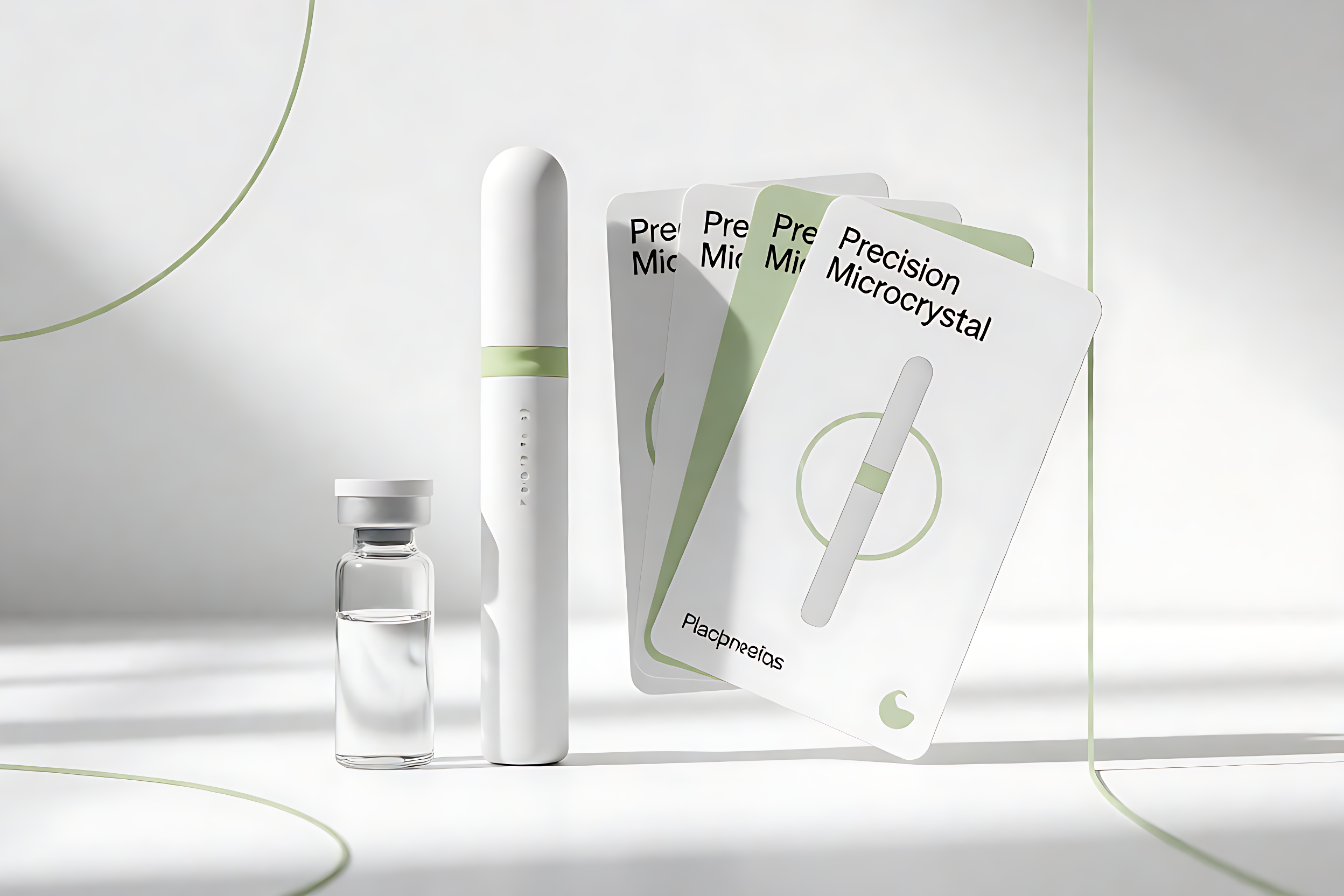
Two buyers, no product between them: consumers who avoid needles but want precision placement (acupoint-inspired rituals), and device partners with applicator hardware and no consumable line matched to it. The needle-free microcrystal program is the pairing: a characterized suspension, a placement map, and carrier chemistry matched to partner hardware.
02 · Scientific rationale
Microcrystal carriers place characterized EVs at guided points with insertion-based or press-on applicators — precision without needles. Placement maps are wellness guidance, worded to stay clear of medical or therapeutic claims; the material layer stays fully documented — same closed-line production, batch COA, and characterization baseline as every TONGNIAN program.
03 · Program documentation
Partner-matching dossiers (carrier chemistry vs. applicator parameters) are maintained in internal device-program files [6].
Method anchors: [1] EV biology and cargo [2] MISEV2018 characterization [3] category evidence (review or registered study) [4] formulation and handling guidance [5] national measurement guideline (2026 No. 17) [6] internal protocol and case documentation.
04 · Product architecture
| Component | Format (sample) | Role |
|---|---|---|
| Acupoint suspension | Sterile professional vials | Clinic tier |
| Guided self-care kit | Suspension + applicator + map | Retail tier |
| Partner consumable | Hardware-matched carrier | Device tier |
05 · Process & QC
EV material runs on the fully enclosed 0.5–5 L micro-batch line with low-shear handling qualified at process validation [4]. QC panel design follows MISEV2018 [2] and the national measurement guideline (2026 No. 17, TONGNIAN a drafting organization) [5].
| Test item | Method | Release criterion (indicative) |
|---|---|---|
| Particle-size distribution | NTA + TEM cross-check | 80–150 nm (sample) |
| Particle concentration | NTA | Per batch COA |
| Endotoxin | Kinetic chromogenic (LAL) | Per batch COA |
| Microbial limits | Membrane filtration | Negative |
| Batch release | COA + batch records | Every batch |
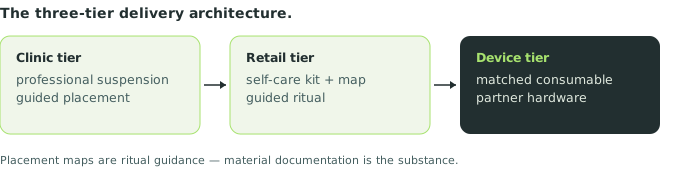
Fig. 1 — The three-tier delivery architecture.
06 · Regulatory pathway: EU & US first
Tiered by setting: clinic suspension under professional-use rules; retail kits on the cosmetic track with placement-ritual wording; device-tier consumables per partner hardware certification. EU/US cosmetic frameworks for retail; material chain documented across all tiers.
07 · Expected outcomes
- Three-tier architecture: clinic, retail, and device partners on one material platform.
- Needle-free positioning: precision placement reaches buyers who refuse needles — demand that needle-based programs never see.
- Partner-ready: carrier dossiers accelerate hardware co-development.
Wording stays inside each destination market's rules; batch measurement does the persuading.
08 · Commercial framework
Sample kits in 3–5 days; pilot from 500 units; production from 2,000 units; standard lead 15 workdays — all indicative, quoted per request. White-label runs through the OBM program.
Request a quote · Line fact-sheet
References
- Kalluri R, LeBleu VS. The biology, function, and biomedical applications of exosomes. Science. 2020;367(6478):eaau6977.
- Théry C, et al. MISEV2018. J Extracell Vesicles. 2018;7(1):1535750.
- Guideline for Exosome Particle Size and Concentration Measurement (2026 No. 17) — TONGNIAN, drafting organization.
- TONGNIAN network clinics. Anonymized internal protocol and case documentation (partner access under NDA).
Apply this playbook to your category
Submit your brand stage, target category, and target volume tier to receive specifications, MOQ, and lead-time quotes for the matching tier (quotation follows the tier structure).