Equine Recovery Program (Exploratory): Partner-Scoped EV Supply for Sport-Horse Recovery
Sport-horse recovery is a premium veterinary segment with clinic precedent for regenerative work — and no documented EV program in it. This playbook scopes an exploratory, partner-led entry.
01 · The problem
Sport-horse medicine runs a premium recovery economy (lameness, joint wear, performance downtime) with clinic precedent for regenerative approaches — and no characterized EV program scoped for it. It extends the companion-animal platform: same material chain, larger per-program budgets, and vets who already run regenerative protocols.
02 · Scientific rationale
The equine regenerative precedent (cell-therapy programs in sport horses) established clinic acceptance and program economics; the EV transposition follows the same veterinary-partner logic with characterized batches and session documentation [3]. Exploration is partner-scoped by design: program parameters (session counts, observation windows) are set with equine veterinarians, not assumed.
03 · Program documentation
Program scoping follows TONGNIAN's internal veterinary-exploration notes and the companion-animal market landscape research (2026-08) [3].
Method anchors: [1] EV biology and cargo [2] MISEV2018 characterization [3] category evidence (review or registered study) [4] formulation and handling guidance [5] national measurement guideline (2026 No. 17) [6] internal protocol and case documentation.
04 · Product architecture
| Component | Format (sample) | Role |
|---|---|---|
| Program scoping | Partner + vet protocol design | The exploration itself |
| Session material | Characterized batches | Program supply |
| Documentation | Session + observation records | The record a partner can audit |
05 · Process & QC
Session material ships characterized on the closed micro-batch line with cold-chain logging; session documentation and observation records are kept per veterinary protocol. QC per the standard panel [2][5].
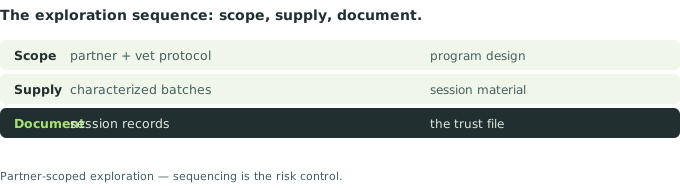
Fig. 1 — The exploration sequence: scope, supply, document.
06 · Regulatory pathway: EU & US first
Regulatory route is set per destination market with veterinary counsel before any program runs; the (Exploratory) label stays until a partner scopes it. Long-range sequencing: companion-animal platform first, equine exploration with veterinary partners second.
07 · Expected outcomes
- Partner-scoped exploration: cost and risk stay inside one program, sized with the veterinary partner before anything runs.
- Premium-segment economics if the program scales into a full caseload.
- Platform leverage: the same material chain serves companion and equine programs.
No claims beyond the destination-market framing — authority comes from documentation and batch measurement.
08 · Commercial framework
Sample kits in 3-5 days; pilot from 500 units; production from 2,000 units; standard lead 15 workdays - all indicative, quoted per request. White-label and program naming run through the OBM program.
Request a quote - Line fact-sheet per program page.
References
- Kalluri R, LeBleu VS. The biology, function, and biomedical applications of exosomes. Science. 2020;367(6478):eaau6977.
- Théry C, et al. MISEV2018. J Extracell Vesicles. 2018;7(1):1535750.
- Companion-animal regenerative market landscape - TONGNIAN desk research, 2026-08.
- Guideline for Exosome Particle Size and Concentration Measurement (2026 No. 17) — TONGNIAN, drafting organization.
- TONGNIAN network clinics. Anonymized internal protocol and case documentation (partner access under NDA).
Apply this playbook to your category
Submit your brand stage, target category, and target volume tier to receive specifications, MOQ, and lead-time quotes for the matching tier (quotation follows the tier structure).