Cold-Chain & Global Delivery: Lanes Matched to Validated Stability Windows
EV material dies in unrefrigerated transit legs, and finished goods arrive warm. This playbook fixes delivery with temperature lanes matched to validated stability windows.

01 · The problem
Exosome programs live and die on logistics: material that loses potency in an unrefrigerated leg, finished goods that arrive warm, buyers who cannot verify what happened in transit. The fix is engineered lanes: material at −20 °C or −80 °C, insulated finished-goods packing with temperature logging, and stability windows (60 days at −20 °C, 360 days at −80 °C on the material line) that set a real shelf life per lane.
02 · Scientific rationale
The lane design follows the material's validated stability profile [5]: material ships in insulated dry-ice lanes for long-haul; finished goods ship per their format windows (2–8 °C cold chain for liquid programs, cool-dry for tablets and patches). Every lane carries temperature logging, and the packing spec (60 L insulated transporter, three-quarter dry-ice fill) is a written document every shipment follows.
03 · Program documentation
Lane specifications and packing documents follow TONGNIAN's internal logistics documentation and the raw-material spec sheet [6].
Method anchors: [1] EV biology and cargo [2] MISEV2018 characterization [3] category evidence (review or registered study) [4] formulation and handling guidance [5] national measurement guideline (2026 No. 17) [6] internal protocol and case documentation.
04 · Product architecture
| Lane | Temperature | Window | Serves |
|---|---|---|---|
| Material long-haul | −80 °C dry ice | 360 days | Intercontinental supply |
| Material regional | −20 °C insulated | 60 days | Regional programs |
| Finished goods | 2–8 °C cold chain | Per format window (final spec per program) | Channel delivery |
05 · Process & QC
Every shipment carries temperature logging; lanes are matched to the program's storage window; destination packing follows the written spec. QC per the standard panel [2][5].
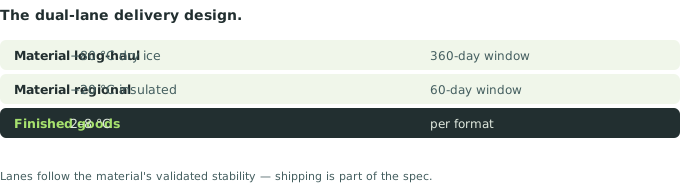
Fig. 1 — The dual-lane delivery design.
06 · Regulatory pathway: EU & US first
Logistics is market-neutral; each destination receives the documentation set its market requires (COA, lane records) alongside the program filings.
07 · Expected outcomes
Lanes are matched to validated stability windows, every shipment carries temperature logging, and the lane design covers intercontinental programs from day one.
No claims beyond the destination-market framing — authority comes from documentation and batch measurement.
08 · Commercial framework
Sample kits in 3-5 days; pilot from 500 units; production from 2,000 units; standard lead 15 workdays - all indicative, quoted per request. White-label and program naming run through the OBM program.
Request a quote - Line fact-sheet per program page.
References
- Kalluri R, LeBleu VS. The biology, function, and biomedical applications of exosomes. Science. 2020;367(6478):eaau6977.
- Théry C, et al. MISEV2018. J Extracell Vesicles. 2018;7(1):1535750.
- Guideline for Exosome Particle Size and Concentration Measurement (2026 No. 17) — TONGNIAN, drafting organization.
- TONGNIAN internal process documentation — closed-line SOPs, QC panels, batch records (partner access under NDA).
Apply this playbook to your category
Submit your brand stage, target category, and target volume tier to receive specifications, MOQ, and lead-time quotes for the matching tier (quotation follows the tier structure).