Clinic Aftercare System: Own the Post-Procedure Moment — In-Clinic and At Home
The problem this playbook solves: clinics deliver controlled injury with precision — then hand patients a loose mix of generic moisturizers. The highest-trust moment in aesthetics has no system, and the aftercare margin goes unmonetized.
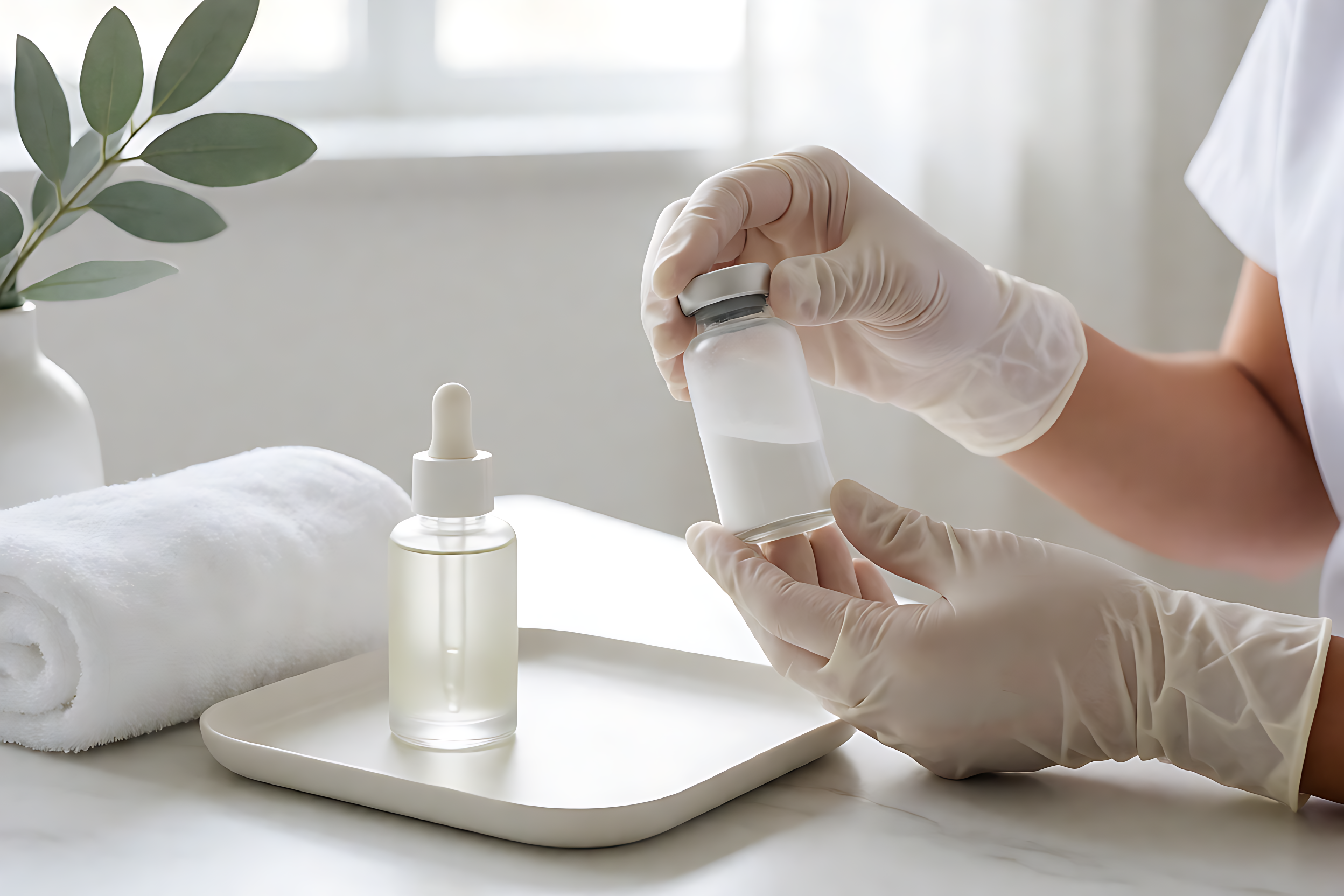
01 · The problem
After laser, microneedling, or energy-based treatment, the clinic owns the patient's full attention for exactly one conversation: "what do I do now?" Three failures decide where that sale lands:
- Protocol fragmentation. Aftercare is a shelf pick, not a protocol; the same chain stocks different products at different locations.
- Trust leakage. The patient buys a generic moisturizer elsewhere; the clinic's clinical authority produces no retail continuity.
- Compliance anxiety. "Active-sounding" aftercare brings claim risk clinics won't touch.
The two-stage system answers all three: professional formats in-clinic, branded continuity at home, one documented material baseline. It converts the clinic's authority into retail revenue instead of leaking it.
02 · Scientific rationale
The post-procedure window is a barrier-disruption and remodelling window. Exosomes are nanoscale vesicles (80–150 nm on TONGNIAN's release spec) carrying proteins, lipids, and microRNAs [1]; MSC-derived EVs are reported in dermatology literature to act on barrier-lipid organization, fibroblast activity and ECM remodelling (TGF-β/Smad-type axes), and visible-calming signals — the exact phases a treated skin passes through [3].
Two design conclusions follow. First, phase-matching: the immediate phase needs cooling-feel, low-touch formats; the rebuild phase needs fresh-activated material (the two-step lyophilized set); continuity needs nothing dramatic — a documented cream. Second, documentation over adjectives: a 2026 systematic review of 19 human studies reports short-term hydration and appearance improvements with early-evidence caveats [3] — so the system's claims discipline is appearance-level by design, which is what clinics can defend.
03 · Internal case experience
TONGNIAN network-clinic case documentation (2022–2024, anonymized) records the pattern this system formalizes: facial programs via injection and needle-free infusion routes with 30-day observation points; client-reported notes on brighter-looking tone and elasticity impressions at observation [6]. The two-stage architecture — professional session formats plus take-home minis — is the direct productization of how those protocols actually ran. Case documentation is presented as protocol-design reference, not trial evidence; the hierarchy stays: published reviews first, internal observational programs second, case documentation third.
The full anonymized series — including the cases behind these protocol patterns — is published in the Case Library.
04 · Product architecture: the two-stage system
| Stage | Setting | Products | Format logic |
|---|---|---|---|
| Stage 1 · In-clinic | Professional session | Point-care essence; multi-use backbar sizes; soothing mist | Professional-use labelling; per-protocol dosing; backbar economics |
| Stage 2 · At-home | Day 3 → day 30 | Two-step lyophilized set; barrier serum; calming mask | Retail-labelled continuation of the same baseline |
| Hand-off | Day 3 protocol card | Brandable program card | The clinic's protocol, printed on the brand's card |
The system sells twice: backbar to the clinic, continuation retail to the patient — one characterization baseline, no re-development between stages.
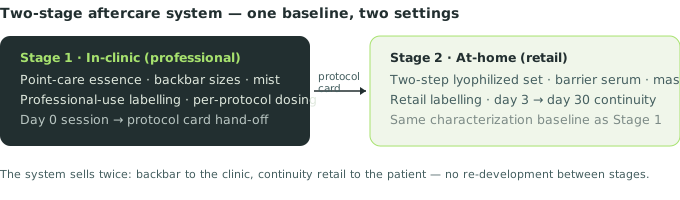
Fig. 1 — The two-stage architecture: protocol card hands the patient from Stage 1 to Stage 2.
05 · Process & QC
All EV material runs on the fully enclosed 0.5–5 L micro-batch line with low-shear handling qualified at validation; the downstream train follows published industrial guidance [4]. QC panel design follows MISEV2018 [2] and the national measurement guideline (2026 No. 17, TONGNIAN a drafting organization) [5].
| Test item | Method | Release criterion (indicative) |
|---|---|---|
| Particle-size distribution | NTA + TEM cross-check | 80–150 nm (sample) |
| Particle concentration | NTA | Per batch COA |
| Endotoxin | Kinetic chromogenic (LAL) | Per batch COA |
| Sterility / microbial limits | Membrane filtration | Negative |
| Batch release | COA + batch records | Every batch |
06 · Regulatory pathway: EU & US professional channels
EU: professional aftercare formats follow Regulation (EC) No 1223/2009 with CPNP notification and PIF/CPSR; professional-use labelling sharpens the claims boundary to appearance and feel. US: MoCRA (2022) registration and listing; INCI labelling (41316 on the EV ingredient) on both markets. The system's claim language stays at "supports the appearance of calm, hydrated skin during the natural recovery period" — worded so clinic legal teams can approve it without redlines. China market entry later maps to the CSAR track on the same material chain — an additional market, not the primary one.
Documentation comparison (what diligence actually checks)
| Documentation / capability | TONGNIAN baseline | Typical market supplier |
|---|---|---|
| FDA DMF Type II on the material line | On file (044197) | Rare |
| INCI registration | On file (41316) | Occasional |
| National standard drafting seat | Yes (2026 No. 17) | Rare |
| Batch COA + characterization baseline | Every batch | Varies |
| Concentration options | Configurable tiers to 100B/mL | Often fixed SKUs |
Market-supplier column reflects qualitative channel observation, not a named comparison.
Fig. 2 — Documentation comparison: the diligence checklist this system passes.
07 · Expected outcomes
Consistent with published evidence [3] and internal observational programs [6]:
- In-clinic phase: skin feels cooled and comfortable at session end; the protocol card gives the patient a written path.
- At-home phase (day 3–30): smoother-feeling texture and calmer-looking complexion are the typical internal observational notes; published reviews report comparable short-term signals.
- System level: the clinic adds a structured aftercare tier; the brand extends one documented ingredient into a take-home line. No accelerated-healing or treatment claims; the documentation carries the trust.
08 · Commercial framework
Clinic pilots scoped per chain (backbar + retail starter); sample kits in 3–5 days; production from 2,000 units; standard lead 15 workdays — all indicative, quoted per request. Professional-use labelling, protocol cards, and staff briefing sheets are included; the full documentation chain is available on demand.
Request a quote · Explore DermFix™ line
References
- Kalluri R, LeBleu VS. The biology, function, and biomedical applications of exosomes. Science. 2020;367(6478):eaau6977.
- Théry C, Witwer KW, et al. MISEV2018. J Extracell Vesicles. 2018;7(1):1535750.
- Systematic review of 19 human studies of topical exosome skin applications, 2026 — summary via DermatologyNews.net.
- Cobetter. Exosomes Part I: Applications and Downstream Processing Overview. Technical review, 2025.
- Guideline for Exosome Particle Size and Concentration Measurement (2026 No. 17), national standard — TONGNIAN, drafting organization.
- TONGNIAN network clinics. Anonymized internal case documentation — facial protocols, 2022–2024.
Apply this playbook to your category
Submit your brand stage, target category, and target volume tier to receive specifications, MOQ, and lead-time quotes for the matching tier (quotation follows the tier structure).