Breathe-Wellness: A Device-and-Refill System for the Shelf Between Humidifiers and Nebulizers
The respiratory shelf offers humidifiers with no active story and clinical nebulizers behind pharmacy gating. This playbook fills the gap: the ritual, the device-and-refill architecture, the QC panel, the claims route. nebulizers with drug framing — nothing in between for a daily breathing-comfort ritual.
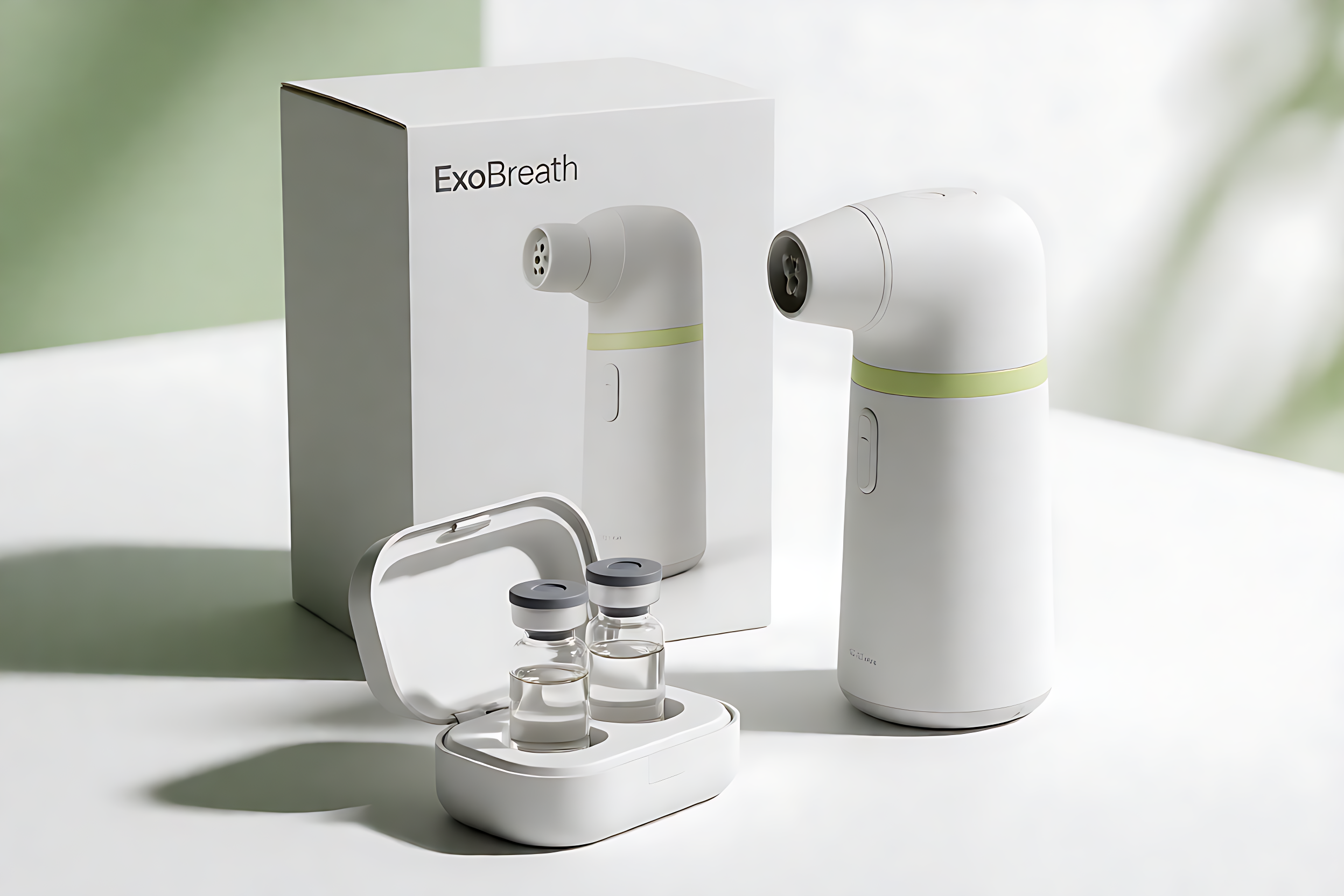
01 · The problem
The respiratory shelf splits into humidifiers (no active story, humidity only) and clinical nebulizers (drug framing, pharmacy gating). Between the two sits a daily breathing-comfort ritual for high-load urban lives — and no product serves it: the consumable is undocumented, there is no device-and-refill model, and no compliance path a channel can merchandise.
02 · Scientific rationale
Exosome nebulization is an active administration-route research area: a registered dose-escalation study of nebulized extracellular vesicles (1–3 × 10⁹ particles per session, twice daily) established the route paradigm in the clinical literature [3]. The wellness version is deliberately modest: a characterized EV solution nebulized as a low-noise mist in ten-minute sessions. The product design is the route and the ritual; the marketing copy carries no claims.
03 · Program documentation
Protocol documentation for this program family is maintained in TONGNIAN's internal files — network-clinic protocol series and anonymized case records where applicable [5]. Partner access under NDA; the evidence hierarchy stays explicit — published reviews first, internal observational programs second, case documentation third. [6]
Method anchors: [1] EV biology and cargo [2] MISEV2018 characterization [3] category evidence (review or registered study) [4] formulation and handling guidance [5] national measurement guideline (2026 No. 17) [6] internal protocol and case documentation.
04 · Product architecture
| Layer | Product | Format | Role |
|---|---|---|---|
| Entry | Breathe Reset Set | Device + 6 vials | The complete starting kit: device and the first six sessions |
| Recurring | Refill packs | 6 / 12 / 30 vials | Subscription-shaped consumable |
| Extension | Silver-age comfort program | Gentle-mist vials | 60+ routine variant |
05 · Process & QC
EV material runs on the fully enclosed 0.5–5 L micro-batch line — closed-tubing culture, scheduled harvest, tangential-flow separation and concentration, sterile filtration — with low-shear handling qualified at process validation [4]. QC panel design follows MISEV2018 [2] and the national measurement guideline (2026 No. 17, TONGNIAN a drafting organization) [3].
| Test item | Method | Release criterion (indicative) |
|---|---|---|
| Particle-size distribution | NTA + TEM cross-check | 80–150 nm (sample) |
| Particle concentration | NTA | Per batch COA |
| Endotoxin | Kinetic chromogenic (LAL) | Per batch COA |
| Microbial limits | Membrane filtration | Negative |
| Batch release | COA + batch records | Every batch |
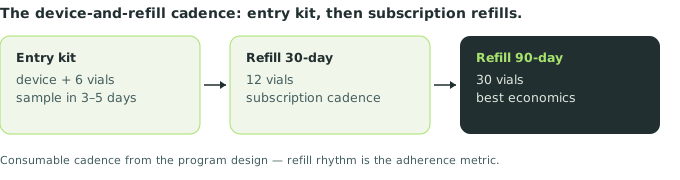
Fig. 1 — The device-and-refill cadence: entry kit, then subscription refills.
06 · Regulatory pathway: EU & US first
The device follows certification routes per destination market (FCC/CE equivalents); the single-dose vials are cosmetic-track consumables on the documented material chain (DMF Type II 044197, INCI 41316). Wellness-routine positioning only — no respiratory therapeutic claims, which is also what keeps the device out of medical-device class in most wellness channels.
07 · Expected outcomes
- Ritual adherence is the program metric: refill cadence (30/60/90-day) tracks it directly.
- Channel economics: the device sells once; refills recur, turning one purchase into recurring revenue on a documented consumable.
- No respiratory claims: comfort-routine language only.
No claims are made beyond the cosmetic, supplement, or professional-use framing of the destination market — authority comes from documentation and batch measurement.
08 · Commercial framework
Sample kits in 3–5 days; pilot from 500 units; production from 2,000 units; standard lead 15 workdays — all indicative, quoted per request. White-label and program naming run through the OBM program.
Request a quote · Line fact-sheet
References
- Kalluri R, LeBleu VS. The biology, function, and biomedical applications of exosomes. Science. 2020;367(6478):eaau6977.
- ClinicalTrials.gov NCT07515066 — nebulized hPMSC-EVs for idiopathic pulmonary fibrosis (route-paradigm reference).
- Cobetter. Exosomes Part I: Applications and Downstream Processing Overview. Technical review, 2025.
- Guideline for Exosome Particle Size and Concentration Measurement (2026 No. 17), national standard — TONGNIAN, drafting organization.
- TONGNIAN network clinics. Anonymized internal protocol and case documentation (partner access under NDA).
Apply this playbook to your category
Submit your brand stage, target category, and target volume tier to receive specifications, MOQ, and lead-time quotes for the matching tier (quotation follows the tier structure).